

A shared path, separate futures
Twins in medical school
Medical school is demanding by design. There is constant pressure, long hours, and an unrelenting amount of information to learn. For some students, this can feel overwhelming.
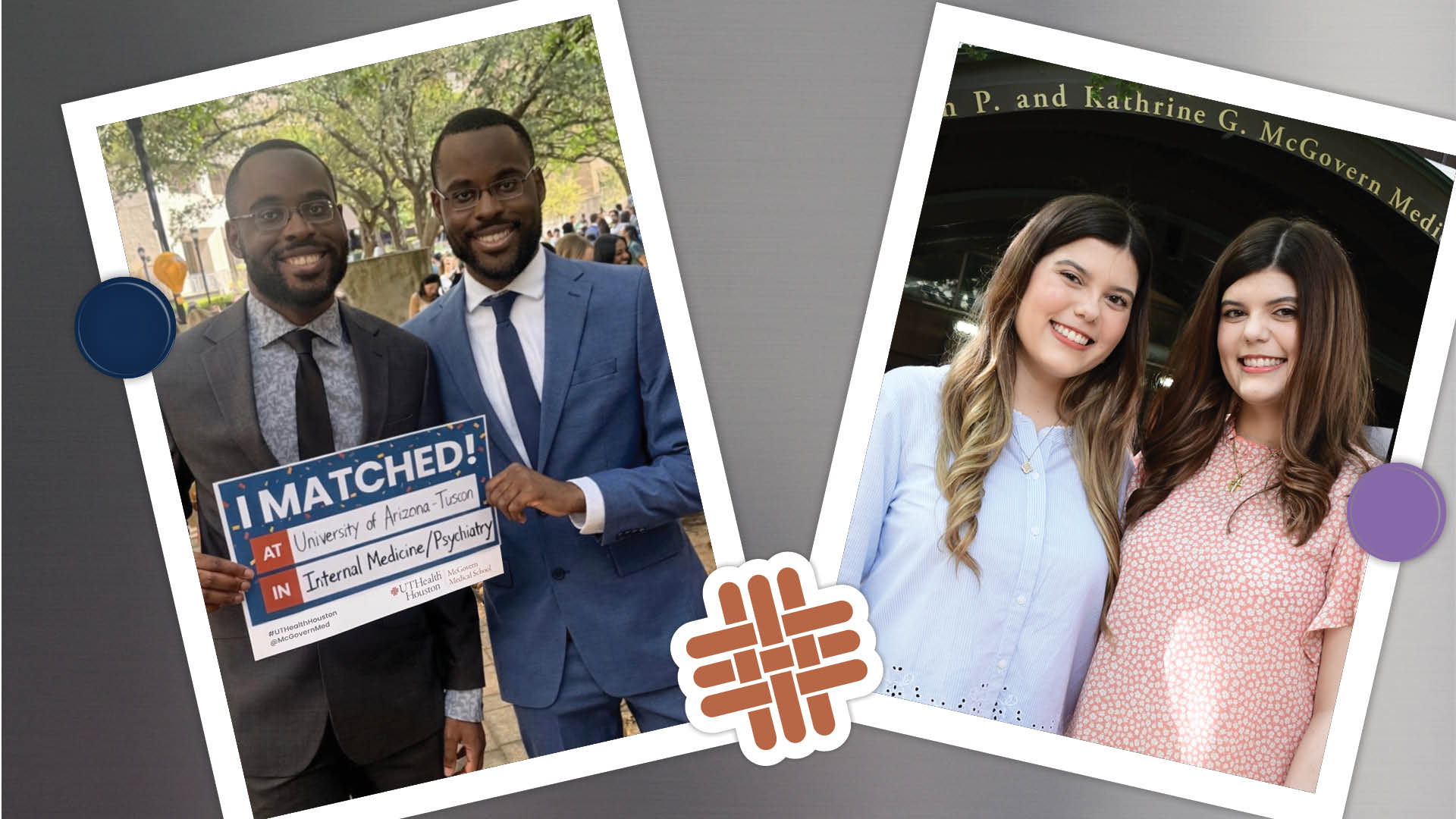
But for a few students at McGovern Medical School at UTHealth Houston, the experience is shaped by something rare: a built-in support system that understands every challenge without explanation. For Amanda and Stephanie Bean, and Andrew and Alousius Fombang, that support comes from the person who has been there from the very beginning—their twin.
Amanda and Stephanie have spent most of their lives side by side. So have Andrew and Alousius. Though they have different families and upbringings, a shared experience has shaped not only who they are, but how they arrived at the same place: medical school.
For the Bean sisters, the journey began with a simple question in early childhood.
“Originally, it was a career day in kindergarten, and one of us, or maybe both of us, decided that we wanted to be physicians,” Stephanie said.
What followed was years of shared curiosity. There were conversations about biology classes, a fascination with the human body, and a constant exchange of ideas that reinforced a common goal.
For the Fombang brothers, the influence to pursue a career in medicine came from home. Medicine was not just an idea, but something they witnessed daily through their mother’s work.
“One of our biggest inspirations for doing medicine was our mother. When we were growing up, she was a registered nurse, and now she’s a nurse practitioner,” Alousius said. “She had a heavy influence on us as individuals, but we also just pushed off each other in almost like a triangle of influence.”
Their path felt less like a decision and more like a natural progression, shaped by both observation and the quiet, steady influence of family.
“I had all these different interests growing up as a kid, but early on I was really sort of locked into medicine,” Andrew said. “Being young and hearing my parents talk about how my mom’s day was at work, you could hear the good stories and the bad stories, but I always enjoyed the stories about having great experiences working with patients and their families.”
“I can’t even point to an exact moment in my life where I decided it was going to be medicine,” Alousius added. “It’s not that I did it on a whim or anything, but it also felt like this was going to be the end outcome.”
In both families, the foundation was the same: a shared environment where ideas, encouragement, and support flowed freely. Growing up as twins meant learning how to be individuals within that shared foundation.
For Amanda and Stephanie, that meant stepping into unfamiliar spaces. Amanda took up theater to push past her natural introversion and gain confidence, while Stephanie found her own voice through music and performances in the choir.
The Fombang brothers experienced a similar evolution, though their differences were less visible at first. For much of their early lives, they moved in near lockstep. They took the same classes, had the same major, and followed the same trajectory. It was not until the intensity of medical school that their differences began to surface.
“It’s really, really funny that it took medical school for us to notice a lot of the differences we have,” Andrew said. “It just speaks to the experience of how you’re exposed to so many different things and so many new things in medical school, and the way you approach it really drove home a lot more differences as individuals that we really hadn’t noticed up until this point.”
What emerged were subtle distinctions in how they thought, how they processed information, how they approached challenges, and the differences that would later shape their individual paths.
Medical school, with all its demands, brought both the strength of their bonds and the need for independence into sharper focus.
For both sets of twins, one thing was immediately clear — They were never alone in the experience.
“I’ve often told friends, family, even some of our classmates, it truly was a blessing being able to go through school with my twin brother,” Andrew said.
That built-in support system extended beyond academics. It meant having someone who understood the weight of the workload, the stress of exams, and the emotional intensity of clinical experiences without needing explanation.
“The most important thing is the lack of filter and complete contextual understanding of each other,” Alousius said. “It doesn’t matter what you’re doing, it’s always great to have someone who’s going through that same experience as you to confide in and talk to.”
Amanda and Stephanie shared that same sense of understanding, though they also had to navigate the early challenge of being perceived as a pair rather than individuals.
“We had that conversation probably 200 times, where every question was ‘Oh, you’re twins?’ or ‘I thought I just saw you,’ with everybody we met, but over time we realized that we were getting a bigger family,” Amanda said.
Over time, classmates and friends began to see them as individuals.
“The friends we met really got to know each of us individually, as Stephanie and Amanda, and not just as ‘the twins,’” Stephanie said. “People that really got to know us have become a greater family for us.”
At the same time, both pairs made intentional efforts to create space for individual growth. Separate rotations, different teams, and distinct experiences in the hospital allowed each of them to develop their own perspectives.
“I feel like me as an individual really only comes out when I’m not with my brother,” Andrew said. “As much as I love him, and he would say the same thing, it’s like once we’re separate, we start to learn who we really are.”
Those individual experiences are now shaping the next phase of their journeys.
For the Fombang brothers, that shift is clear. After years of moving in parallel, they will enter different specialties after graduation this summer and take a significant departure from their shared path.
Andrew is pursuing psychiatry, while Alousius is interested in internal medicine. The decision reflects not just differing interests, but the gradual emergence of independent identities.
“I often tell this joke where I feel like us deciding to go into different specialties is like the first unique individual thought that we’ve had apart from each other in our lives,” Andrew said.
As they finish their second year of medical school, the future for the Bean sisters is still unfolding. Their experiences have led them toward different interests. They both enjoy internal medicine and neurology, but Stephanie has been drawn to oncology or neuro-oncology, and Amanda favors stroke care.
“The roads may converge. We have to wait and see, but it’s interesting how we’re prioritizing these different experiences,” Stephanie said. “It may end up that we both choose the same specialty, but right now we don’t know. Interests can come about in different ways, so we’re still exploring, but that’s the fun part of being a twin at medical school.”
Along the way, both sets of twins have come to understand that even the closest relationships require care.
For Amanda and Stephanie, that realization has transformed their bond into something more intentional. It’s a partnership built on mutual respect and effort.
“This relationship takes a lot of work. We’ve always been best friends, but you can’t take that blessing for granted,” Amanda said. “It is a relationship that, despite its closeness, requires attention and patience.”
For Andrew and Alousius, growth has come through embracing differences rather than avoiding them. The pressures of medical school have revealed small but meaningful contrasts in their personalities and routines, prompting a shift in how they navigate conflict.
“Growing up as twins, we tried to avoid interpersonal conflict between the two of us, because we knew that conflict would spread into other things,” Alousius said. “And now that we’re in medical school, where our relationship is probably stronger, we embrace conflict between ourselves a little more. Diamonds form under stress, and I feel like we’re closer for that reason.”
Behind both journeys is a broader family network that continues to provide support and motivation. For the Bean sisters, their parents’ pride reflects both the rarity and significance of their shared accomplishment.
“It’s funny that any time my mom tells others that both of her daughters are going to become doctors, everyone’s jaws drop.”
For the Fombang brothers, family remains a constant source of purpose, reinforcing the idea that their work extends beyond themselves.
“Everything’s always a reminder that you do everything not just for yourself, but for those around you and your loved ones,” Alousius said.
Though their paths may soon separate, the foundation remains unchanged.
Both pairs of twins have built their journeys on the same core principle: Family, whether defined by shared childhoods, shared experiences, or shared purpose, is not just part of the story. It is what makes the story possible.