Before the First Shift: New Program Prepares Students for Residency

It feels like the middle of the night when a fourth-year medical student steps into a patient’s room. The patient has not urinated since undergoing surgery two days earlier. With limited information and no clear path forward, the student must determine what to do next.
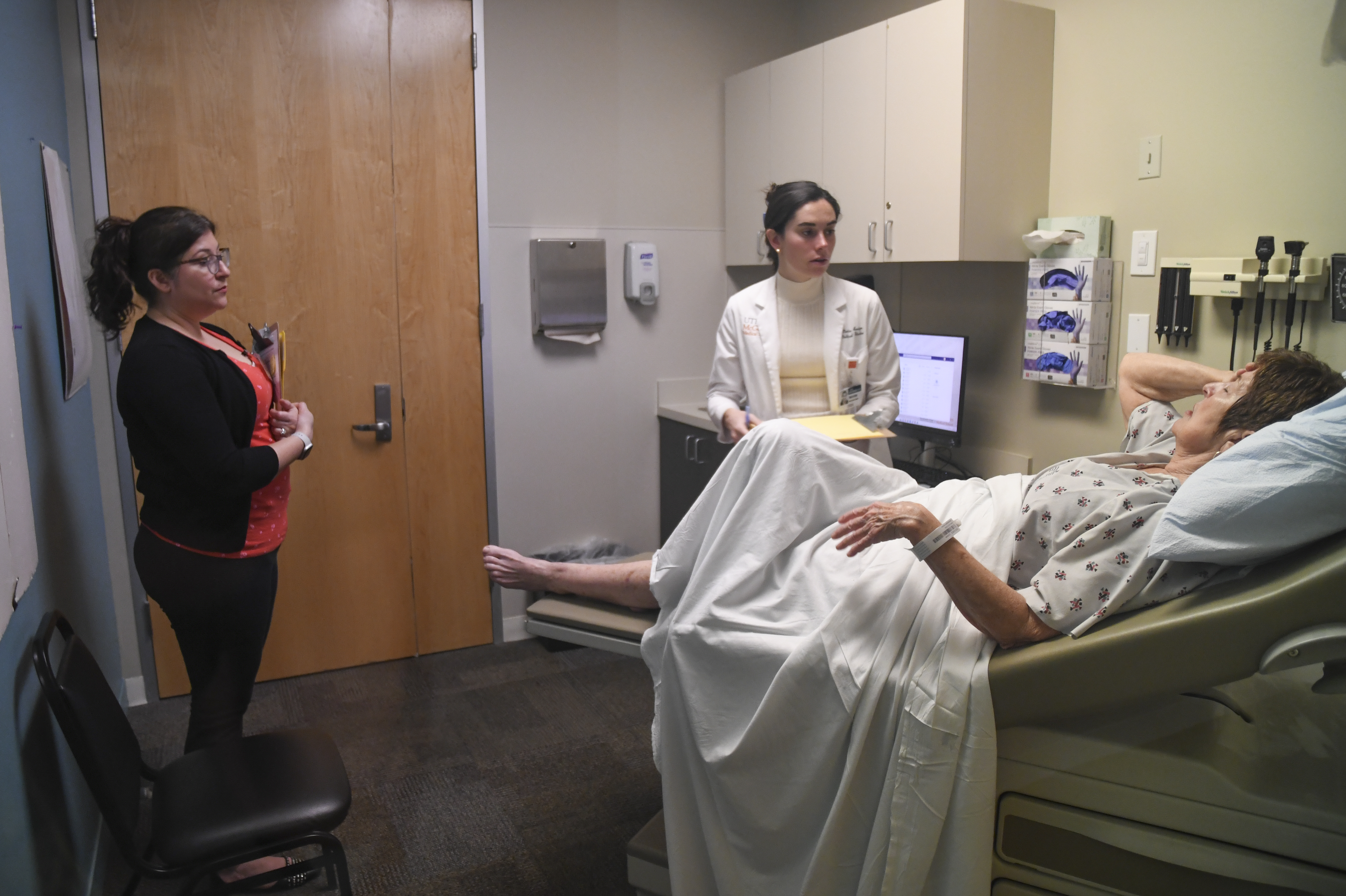
The patient is a standardized patient, an actor portraying a realistic clinical scenario, but the lessons are real. This exercise is part of Night on Call, an immersive simulation in the Surgical and Clinical Skills Center at McGovern Medical School at UTHealth Houston, designed to help fourth-year students prepare for residency.
For recent graduate Russell Welton, MD ’26, the experience was unlike any simulation he had encountered during medical school.
“Honestly, I was pretty nervous, even though I knew it wasn’t graded,” he says. “It was the first time I was not only seeing the patient but also making decisions and directing other professionals on what to do, largely on my own.”
Originally developed by a small consortium of medical schools, Night on Call launched at McGovern Medical School in 2023 under the leadership of Allison Ownby, MD, MEd, Associate Dean for Educational Programs; Hilary Fairbrother, MD, MPH, Assistant Dean for Pre-Clerkship Education; and Bindu Akkanti, MD, Assistant Dean of Clinical Education and Graham Distinguished Professor in Pulmonary Medicine. What began with 48 students in 2023 has since expanded to include all 240 students of the fourth-year class. The transition from medical school to residency is one of the most significant shifts in a physician’s training. New residents are suddenly expected to make clinical decisions, communicate effectively with healthcare teams, and manage patient care with a level of independence they have not previously experienced.
During the three-hour shift in the Night on Call program, students assume the role of an intern covering an internal medicine service overnight, tackling patient encounters that mirror the responsibilities they will soon face as resident physicians.
“We want to simulate these experiences so that when they go into the world, they have a sense of muscle memory and security that they’ve done this before,” Akkanti says.
Instead of a traditional grade, students receive feedback from faculty members, standardized patients, and nurses, creating what Fairbrother describes as a 360-degree review of the skills they will need in residency.
The scenarios challenge students to evaluate patients, obtain informed consent for procedures, communicate with family members, collaborate with nurses, and address patient safety concerns. One component requires students to research a clinical question, with librarians from the Texas Medical Center Library evaluating not only the answer they find but also how they search and assess sources.
For Russell, the experience felt notably different from other simulations he encountered during medical school.
“There were, in my mind, fewer training wheels than in other simulations,” he says. “No one was there to hold your hand. It pushed you to do your best.”
After completing the cases, students participate in a patient handoff exercise before meeting individually with faculty members to review their performance. One of the moments that stands out most to Russell came when he was required to call an attending physician and quickly present a patient case along with a proposed plan of care.
“It was such a short period of time between having just seen the patient and then making a multistep decision on what I was planning,” he says. “That time limitation put some pressure on me to lock in and focus.”
Russell, who will begin an internal medicine residency at the San Antonio Uniformed Services Health Education Consortium, says the experience reinforced the realities of the transition from medical school to residency. For the first time, he found himself making decisions that others would act upon, a responsibility that soon will become part of his daily work as a physician.
“It showed me how crucial it will be to think critically on my feet,” he says.
For students preparing to make the transition from medical school to residency, Night on Call offers an opportunity to practice the decisions, conversations, and responsibilities they will soon face as physicians—before the stakes become real.