

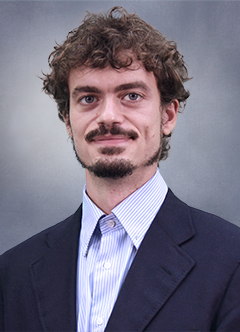
Luca Giancardo, Ph.D. joined the UTHealth School of Biomedical Informatics (SBMI) on December 1, 2016 as an assistant professor and a core faculty member of the Center for Precision Health.
Before arriving at SBMI, he was a research fellow at the Massachusetts Institute of Technology, leading the technology development of a research endeavor to detect early signs of Parkinson's Disease via the daily interaction with electronic devices. This work allowed him to be the recipient of funding from the Michael J. Fox Foundation and to win the 2015 Singapore Challenge.
Between 2011 and 2013, he was a Postdoctoral Fellow at the Italian Institute of Technology where he worked on new tools for analysing mice behaviors as well as analysis methodologies for highly-dimensional magnetic resonance imaging data. During his doctoral studies at the Oak Ridge National Laboratory (ORNL) and Université de Bourgogne, he worked on many different retina analysis algorithms to automatically screen diabetic patients for retinopathy and macular edema. The result of his work is currently been translated to industry and various prizes were awarded to his research team; the R&D Award by R&D Magazine, ORNL Award Excellence in Technology Transfer, ORNL Significant Event Team Award and FLC South-east Regional Award Excellence in Technology Transfer. His passion is to find unmet medical need and build translatable technologies to tackle them.
“The vast quantity of heterogeneous data can transform medical diagnostics only when coupled with thoroughly validated computational algorithms able to distill clear and actionable medical information.” Giancardo said, “During my research career I focused on theory and applications of image/signal analysis algorithms, machine learning and computer vision in order to tackle these medical needs. By doing so, I learned how to interchange ideas, collaborate and present results to experts coming from fields different that mine (clinicians, physicists and biologists) and facilitate discussion among them.”
Education
- PhD, Computational Image Analysis, 2011, Oak Ridge National Laboratory and Université de Bourgogne (France)
- MSc, Computer Vision and Robotics, 2008, Heriot-Watt University, Edinburgh (UK), Universitat de Girona (Spain) and Université de Bourgogne (France)
- BSc (Hons), Software Engineering, 2005, Southampton Solent University (UK)
Research
- Medical Image/Signal Processing
- Machine Learning
- Big Data
- Translational Medicine
Publications
- Arroyo-Gallego, T., Ledesma-Carbayo, M, Sanchez-Ferro, A., Butterworth, I., Mendoza, C., Matarazzo, M., Montero, P., Lopez-Blanco, R., Puertas-Martin, V., Trincado, R. and Giancardo, L*. Detection of Motor Impairment in Parkinson's Disease via Mobile Touchscreen Typing. IEEE Trans Biomed Eng in press, (2017).
- L Giancardo, A Sanchez-Ferro, T Arroyo-Gallego, I Butterworth, C Sanchez-Mendoza, P Montero, M Matarazzo, J A Obeso, M L Gray and R. San José Estépar, “Computer keyboard interaction as an indicator of early Parkinson's disease”, Scientific Reports 6, Article number: 34468, 2016.
- T Arroyo-Gallego, M Ledesma-Carbayo, A Sanchez-Ferro, C Sanchez-Mendoza, I Butterworth, M Matarazzo, P Montero, R López-Blanco, V Puertas-Martín, R Trincado and L Giancardo, “Detection of Motor Impairment in Parkinson's Disease via Mobile Touchscreen Typing”, IEEE Biomedical Engineering (under review).
- A Crimi, L Giancardo, A Gozzi, F Sambataro, V Murino, D Sona, “Multi-Link Discrimination: Brain Network Comparison via Sparse Connectivity Analysis”, Neuroimaging (under review).