
Smarter together: Helping complex research teams work efficiently
About the Team Science Component
The CCTS Team Science component helps research teams work more effectively by applying evidence-based strategies drawn from the science of team dynamics. While most research teams form organically—without formal guidance—decades of research show that intentional teamwork practices lead to stronger collaboration, improved outcomes, and more innovative science.
Our approach is rooted in the science of team science (SciTS)—a cross-disciplinary field focused on understanding and improving how research teams collaborate. SciTS provides practical, evidence-based strategies for everything from goal alignment and communication, to conflict resolution and leadership in complex team environments.
In translational research, collaboration is especially complex. Teams often span disciplines, departments, and institutions, forming multi-team systems. These teams frequently encounter preventable challenges that can stall or derail progress. The CCTS Team Science component is designed to help teams address these issues early and effectively.
Why should you partner with us?
If you are part of a research team at one of the CCTS partner organizations, we can help you:
- understand your team's collaboration patterns
- build skills for more effective teamwork
- apply best practices tailored to your goals
Leadership and Staff
| Eric Thomas, MD, MPH, Director | [email protected] | 713-500-7958 |
| Eduardo Salas, PhD, Director | [email protected] | 713-348-3917 |
| Gabriela Fernández Castillo, PhD | [email protected] | 713-500-7928 |
The Team Science component is aided by the experience and backgrounds of its personnel:
Eric J. Thomas, MD, MPH, professor of medicine and associate dean for healthcare quality at McGovern Medical School, UTHealth Houston, directs the UTHealth Houston—Memorial Hermann Center for Healthcare Quality and Safety and has conducted pioneering work on measuring team behaviors.
Eduardo Salas, PhD, professor and Allyn R. and Gladys M. Cline chair at Rice University, is a world leader in teamwork and team training.
Gabriela Fernández Castillo, PhD, specializes in understanding and improving how complex, interdisciplinary research teams collaborate to enhance effectiveness in scientific and healthcare settings.
The CCTS Team Science component provides a range of services to support collaboration in research teams from early-stage planning to long-term development.
For assistance with any of the following services, please email Gabi Fernández Castillo at [email protected].
Grant Planning and Team Support
Whether you're preparing a competitive multi-site grant application, or navigating, the early stages of a funded project, we can help you build the structure your team needs to succeed. We work with investigators to create a shared plan for how the team will operate (e.g., roles, expectations, decision-making) and to determine what each site needs in order to participate successfully. We can also assist with the logistics of coordinating multiple institutions. Our support is tailored to your project's specific stage, whether you're just beginning, refining your approach, or troubleshooting coordination challenges on an active award.
Education and Training
Our workshops and training sessions are designed to help teams and individuals work together more effectively, from foundational sessions on what makes a team successful, to more focused topics, such as leadership and planning for collaboration. Sessions can be delivered in person, virtually, or through the use of materials your team can go through at their own pace. Content and format are tailored to your audience.
TeamMAPPS
To assist scientific teams in improving team performance, we offer a behavioral skills training program led by Gabriela Fernandez, PhD. Developed at The University of Texas Medical Branch (UTMB), the program, Methods to Advance Performance and Processes in Science (TeamMAPPS), includes five online, self-paced asynchronous modules and three synchronous interactive discussion sessions. Participants receive a certificate of completion at the end of the program.
Team Coaching and Assessments
Sometimes a team senses that something isn't working quite right, but the exact reason is hard to pinpoint. We offer an outside, objective perspective to help teams recognize whatever is getting in the way, whether it's communication, trust, decision-making, division of workload, etc. Using evidence-based assessment tools, we can help identify the root causes and deliver a clear action plan that your team can put into practice. The solutions could range from a single conversation to talk through an issue, to an ongoing series of check-ins as your team addresses a challenge, or a structured assessment gathered directly from your team members. The coaching we provide is grounded in research on team effectiveness and can be applied at any stage of a project.
Events and Trainings
Stay connected and keep learning by participating in our events, including talks, lunch-and-learn sessions, and interactive workshops.
View the CCTS calendar.
Recommended readings and media
This resource contains the main journals, pertinent articles, books, book chapters, and more, all related to team science: Oxford Bibliographies
Books
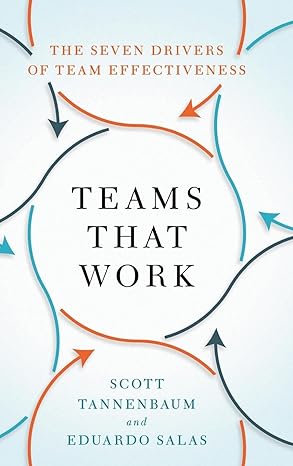 |
Teams That Work: The Seven Drivers of Team Effectiveness, by Scott Tannenbaum and Eduardo Salas |
Articles
Bisbey, T. M., Reyes, D. L., Traylor, A. M., & Salas, E. (2019). Teams of psychologists helping teams: The evolution of the science of team training. American Psychologist, 74(3), 278–289. https://doi.org/10.1037/amp0000419
Hall, K. L., Vogel, A. L., Huang, G. C., Serrano, K. J., Rice, E. L., Tsakraklides, S. P., & Fiore, S. M. (2018). The science of team science: A review of the empirical evidence and research gaps on collaboration in science. American Psychologist, 73(4), 532–548. https://doi.org/10.1037/amp0000319
Hughes, A. M., Gregory, M. E., Joseph, D. L., Sonesh, S. C., Marlow, S. L., Lacerenza, C. N., Benishek, L. E., King, H. B., & Salas, E. (2016). Saving lives: A meta-analysis of team training in healthcare. Journal of Applied Psychology, 101(9), 1266–1304. https://doi.org/10.1037/apl0000120
Suggested conferences
INGRoup, the interdisciplinary network for group research. Learn more at ingroup.net.
For assistance, please email Gabi Fernández Castillo at [email protected].