


An aging-in-place laboratory
The American Association of Retired Persons estimates that 90% of the nation’s quickly growing population of older adults want to live in their own homes for as long as possible.
Enabling independent living requires collaboration among disciplines such as nursing, medicine, architecture, engineering, technological design, social work, mental health services, economics, financial planning, policy, and legal services.
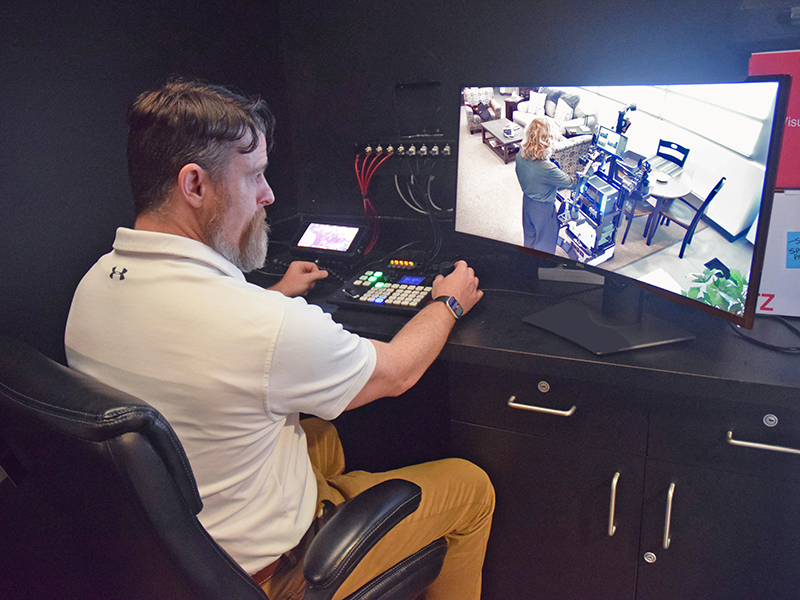
The Cizik Nursing Research Institute’s Smart Apartment is designed for testing aging-in-place technology, programs, and other solutions designed to support independent living for older adults and people living with disabilities.
This fully furnished, one-bedroom home is housed within Cizik School of Nursing at UTHealth Houston’s building in the Texas Medical Center. This laboratory is equipped with sensors, monitors, robots, and other devices that researchers use to test technologies that can help monitor self-management of chronic diseases and detect health and behavior changes in aging and disabled adults.
For additional information about resources and capabilities, please contact Dr. Shayan Shams.
Schedule a tour of the Smart Apartment.
2026-2027
Smart Apartment
Pilot Awards
Call for Applications
The CNRI invites UTHealth Houston faculty to propose focused pilot studies that use the CNRI Smart Apartment to generate preliminary data for an R01 or another major external award. Two awardees will receive full CNRI Smart Apartment infrastructure, data, and personnel support, plus up to $20,000 in direct costs provided to the principal investigator for approved project expenses. Get the details and apply by Nov. 6, 2026.
Located in the Texas Medical Center, the CNRI's Smart Apartment supports technology-enabled research focused on maintaining function, independence, and health across aging, with additional applications in chronic conditions, disability, rehabilitation, and caregiving. The home-like environment allows investigators to evaluate technologies and multimodal data under controlled, realistic conditions before extending studies into participants' homes.
Project configurations, device integration, data capture, staffing, and governance requirements are scoped through consultation with the CNRI Smart Apartment team.
-
Physical environment and layout
- Fully functional one-bedroom home environment with living area, kitchen, bedroom, bathroom, household furnishings, appliances, and transition/mobility spaces.
- Configurable for realistic home-context scenarios involving mobility, medication management, meal preparation, sleep, safety, technology interaction, and other activities relevant to aging and independent living.
-
Sensing, devices, and smart-home technology
- Fixed 4K video capability plus environmental, movement, occupancy, appliance, and fixture sensing, including refrigerator, stove, toilet, bed, and mobility-related sensing.
- Voice and smart-home interfaces, medication dispensers, smart appliances, assistive technologies, and access to robotic platforms; investigator-supplied devices can also be incorporated following technical and safety review.
- Supports integration of wearable, physiologic, smartphone, device-log, audio/voice, video/computer-vision, environmental, and participant-reported data streams for multimodal research.
-
Computing, data, and analytic capabilities
- Local computing and edge-processing resources include computers, a server array, multi-GPU compute, and GPU edge devices, supporting computationally intensive sensing, AI/ML, computer-vision, and digital-health applications.
- Technical expertise spans data science, AI/ML, natural language processing, informatics, software/device integration, biostatistics, and computer science.
- CNRI can support protocol and scenario development, sensor/device/algorithm validation, multimodal phenotyping, digital biomarker development, adaptive interventions, early-detection studies, and AI-in-the-home research.
- Project-specific support can include participant visits, data capture, ground-truth annotation, raw/organized/processed data products, analysis, technical reports, figures, and grant- or manuscript-ready methods language.
-
Research Question Quick Reference
Starting research question
Purpose
Best fit for
Example research questions
Can people use it?
Test whether a technology or technology-enabled intervention is usable, acceptable, and feasible in a realistic home environment.
Technologies that need user testing, refinement, or feasibility data before a larger pilot or trial.
Can older adults independently use this remote-monitoring system? Does a voice interface reduce burden compared with a touchscreen? What features cause confusion, errors, or technology abandonment?
Does it measure correctly?
Validate sensors, devices, and algorithms against known behaviors and synchronized ground truth.
Investigators who need to establish accuracy, reliability, robustness, false-positive rates, or performance across different users and conditions.
Can passive sensors accurately detect medication-taking behavior? Does a fall-detection algorithm distinguish falls from routine household activity? Does an algorithm retain accuracy among people with mobility impairment?
What can the data tell us about the person?
Integrate synchronized behavioral, environmental, physiologic, sensor, and self-report data to characterize function, symptoms, resilience, or vulnerability.
Studies seeking to understand complex human states that cannot be captured well by a single measure or data stream.
Which combination of digital signals best characterizes functional reserve? How do physiology, movement, and task performance change with fatigue? Can multimodal patterns identify distinct risk or response phenotypes?
What can the data tell us about the person?
Develop and validate meaningful digital measures from raw sensor or device data.
Investigators who have digital data but need to establish whether derived features represent a clinically or scientifically meaningful construct.
Can gait variability serve as a digital biomarker of cognitive vulnerability? Can speech and movement features quantify fatigue? Can passive activity measures provide a more sensitive outcome than a questionnaire?
Can the system respond intelligently?
Test closed-loop interventions in which sensing or contextual information triggers individualized support or intervention.
Just-in-time, adaptive, sensor-triggered, or context-aware interventions.
When should a system prompt someone who appears to have missed a medication? Does adaptive cueing support independence better than fixed prompting? Which signals should trigger caregiver notification?
Can the system respond intelligently?
Evaluate AI-enabled systems in realistic home interactions, including usefulness, safety, adaptation, trust, and escalation decisions.
AI assistants, conversational agents, predictive tools, intelligent monitoring systems, and AI-enabled interventions intended for home use.
Can an AI assistant recognize emerging confusion? When should an AI system escalate a potential safety concern? Can AI coaching adapt appropriately to cognitive, sensory, or mobility limitations?
Can it identify risk before conventional assessment does?
Identify subtle changes in everyday activity, function, physiology, or routines that may signal emerging risk or decline.
Early detection, longitudinal monitoring, prevention, recovery tracking, and development of digital warning signals.
Can changes in household activity identify emerging mobility decline? Do increases in task variability precede clinically apparent cognitive change? Can deviations from an individual's usual pattern signal elevated health risk?