

EHS Main Office 713-500-8100 (answered M-F, 8:00AM-5:00PM CST)
EHS Hotline 713-500-5832 (after hours, weekends, holiday for the on-call safety specialist)
For Emergencies, Dial UT Police Dispatch 713-792-2890 or 911
Submit a Safety ConcernSupervisor's First Report of Injury Form
Safety, Health, Environment & Risk Management’s (SHERM) mission is to work in conjunction with the UTHealth Houston community to ensure that education, research, and health care service activities take place in conditions that are optimally safe and healthy for all students, faculty, staff, visitors, the surrounding community, and the general public.
Put simply, we exist to help people go home as healthy and safe as they arrived.
Our main office is located at the Operations Center Building (OCB 1.330) and our secondary office is within the Cyclotron Building (adjacent to the McGovern Medical School Building). We can be reached at 713-500-8100 or [email protected], and if needed by fax at 713-500-8111.
Dr. Kristin King recognized by American Biological Safety Association (ABSA-International) for the Robert Hashimoto Service Award

On October 14, 2026 the American Biological Safety Association (ABSA-International) recognized Dr. Kristin King, Safety Manager, Biological Safety Program with the Robert Hashimoto Service Award (also known as the "Hash Award) at the 69th Annual Biosafety & Biosecurity Conference in Mobile, Alabama. This prestigious award recognizes biosafety professionals who have contributed by serving and leading on committees for the association, which represents biosafety and biosecurity professionals around the world. Kristin’s service on the Credentialing Evaluation Board is just one of many ways she has contributed to the association – she also frequently provides scientific presentations, teaches professional development courses, and actively contributes to the scientific literature with peer reviewed publications. She has also recently served as President of the Southern Biosafety Association, the local affiliate chapter if ABSA-International representing biosafety professionals in Texas and surrounding states.
Kristin has been with UTHealth Houston for 15 years. She holds a Doctor of Public Health in Occupational and Environmental Health Sciences (minor in epidemiology and leadership) from The University of Texas School of Public Health (UT SPH) and a Master of Public Health in Occupational and Environmental Health Sciences from the same school. Kristin uniquely holds professional credentials in both healthcare and biological safety and has published in peer-reviewed journals in both fields. Previously, Kristin served as a Clinical Safety Coordinator and Biological Safety Specialist at UTHealth Houston, and as a Laboratory Manager for a high-containment laboratory at The University of Texas Medical Branch. From all of us at Safety, Congratulations on this award and thank you for all that you do!
Personal Dosimetry Update
We are happy to announce that, effective January 1, 2026, we will be transitioning the UTHealth Houston radiation dosimetry program from the current dosimetry vendor (Landauer) to a new vendor called Radiation Detection Company (RDC) that is based out of Georgetown, Texas. For current participants in the radiation dosimetry program, your radiation dosimetry badge will look a bit different after the transition. Rest assured the new dosimeters also meet rigorous laboratory accreditation (NVLAP) requirements. We are happy to announce that, effective January 1, 2026, we will be transitioning the UTHealth Houston radiation dosimetry program from the current dosimetry vendor (Landauer) to a new vendor called Radiation Detection Company (RDC) that is based out of Georgetown, Texas. For current participants in the radiation dosimetry program, your radiation dosimetry badge will look a bit different after the transition. Rest assured the new dosimeters also meet rigorous laboratory accreditation (NVLAP) requirements. Select the link below for more information about this new service and how to check your individual dosimetry record.
| Personal Dosimetry Service Update |
Reminder about PPE use:
This is a reminder to all research personnel that Personal Protective Equipment (PPE) should not be worn outside of the laboratory setting. Recently there have been instances of people observing researchers wearing in public spaces, specifically using gloved hands to open doors or push elevator buttons. After all, do you really know where that glove has been?
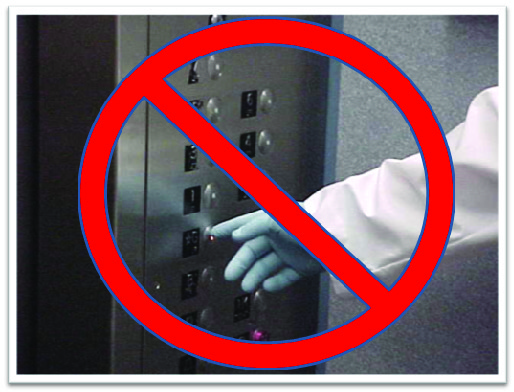 |
Please do not wear gloves or other PPE outside of the laboratory, especially on elevators, in hallways, or in break rooms. |
If it is necessary to transport items between labs on the same floor, one hand may be gloved, while the other hand remains without a glove to open the doors between labs. Gloves should never be worn in the elevator or break rooms. Ideally items should be transported using carts and secondary containment, especially when transporting items between floors.
UT Health Services and the Office of Safety, Health, Environment, and Risk Management are pleased to announce the process for reporting a workplace injury is now online. The Supervisor's First Report of Injury is required when medical attention is necessary from a workplace injury. With the announcement of this online form, listed below are some resources that will help navigate this new system.
Supervisor's First Report of Injury Training video, this training video requires a UTHealth Houston employee to sign in.
Supervisor's First Report of Injury Education (PDF)
Bloodborne Pathogen (BBP) Exposure FAQ (PDF)
STEPS TO BE TAKEN IN EVENT OF A NEEDLESTICK / BLOODBORNE PATHOGEN EXPOSURE (UT Health Services)
Join Dr. Robert "Safety Bob" Emery, as he talks about the Office of Safety, Health, Environment, and Risk Management (SHERM)’s service roll at UTHealth Houston, invited university peer reviews, client satisfaction surveys, and how it all ties together with our research and publications in the scientific literature. Please visit SHERM Academics for information on our link with the UT School of Public Health’s Department of Environmental and Occupational Health Sciences which includes academic course instruction, student practicum opportunities for real-world learning experiences, and recent publications in the peer-reviewed scientific literature.
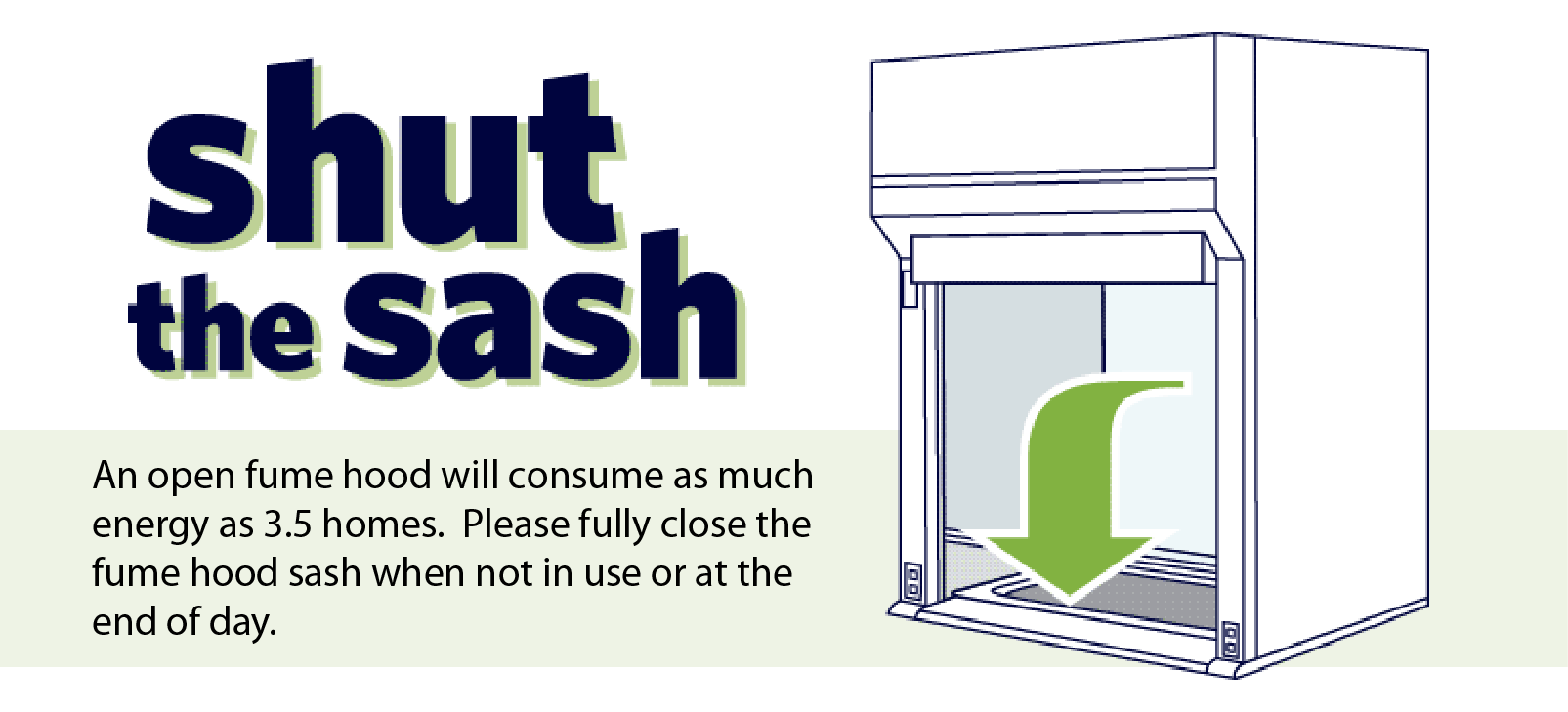
Environmental Health & Safety (EHS) and Facilities, Planning & Engineering (FPE) have partnered to help educate research staff on the safe and energy-efficient use of chemical fume hoods within our UTHealth Houston laboratories. Here is why we care about the chemical fume hood sash height:
For safety:
When using a chemical fume hood, keeping the sash height at the designated height (which is clearly indicated by a bright yellow sticker) helps protect users from potentially dangerous chemical fumes and splashes.
For energy conservation:
Fully closing the fume hood sash when not in use, or at the end of the day after use, helps to save a considerable amount of energy.
Did you know?
- A single open fume hood consumes as much energy as 3.5 residential homes!
- Closing the fume hood sash helps to reduce the amount of air exhausted out of the building, therefore reducing the amount of air that must be conditioned within the lab space by the building’s HVAC system.
- Energy savings = cost savings for UTHealth Houston!
We now have the capability to remotely monitor chemical fume hood performance, so don’t be surprised if you see a friendly EHS or FPE staff member coming by your laboratory to provide a reminder about keeping the fume hood sash closed when not in use.
Thank you for doing your part to work safely and energy efficiently!
All about Safety Training
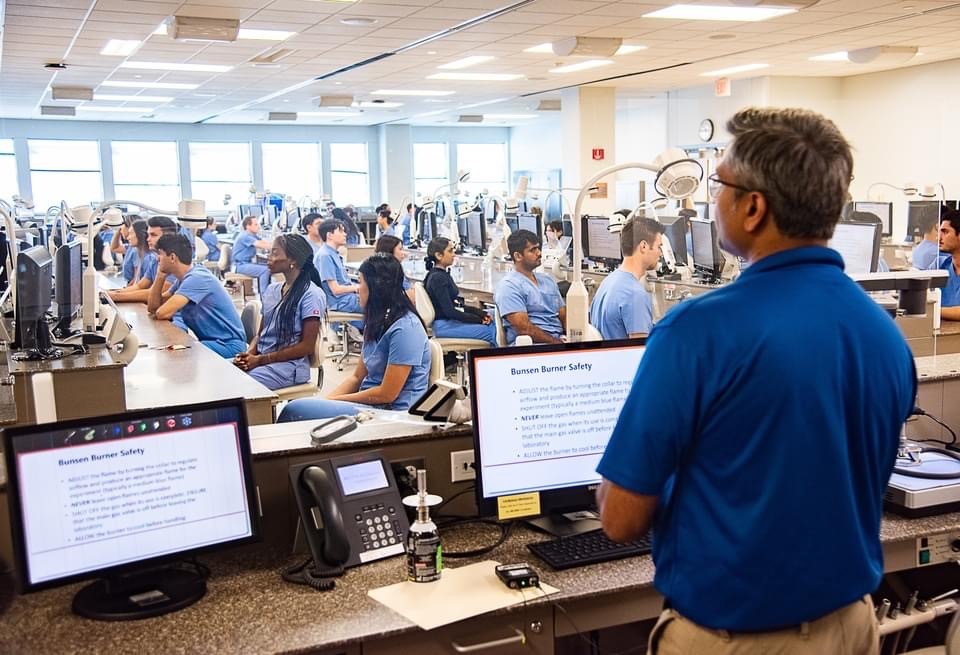
All laboratory and clinic based employees are required to take an Initial Safety training course and then an Annual Refresher training course one year from the date of your initial training. Our courses are available online through our EHS learning management system . For more information about our training, please visit here.
If an in-person training class is desired, please contact EHS at 713-500-8100 to schedule a training session.
Upcoming Classroom led Safety Training
Basic Radiation Safety Training
October 7-8, 2026
9:00 am - 12:00 pm
Cyclotron building Training Room
Attendees are required to participate on both days
Virtual training may be scheduled upon request
For directions to the Cyclotron building or CYF.
For a map using Google Maps click here