

cDNA-PCR Sequencing
Overview
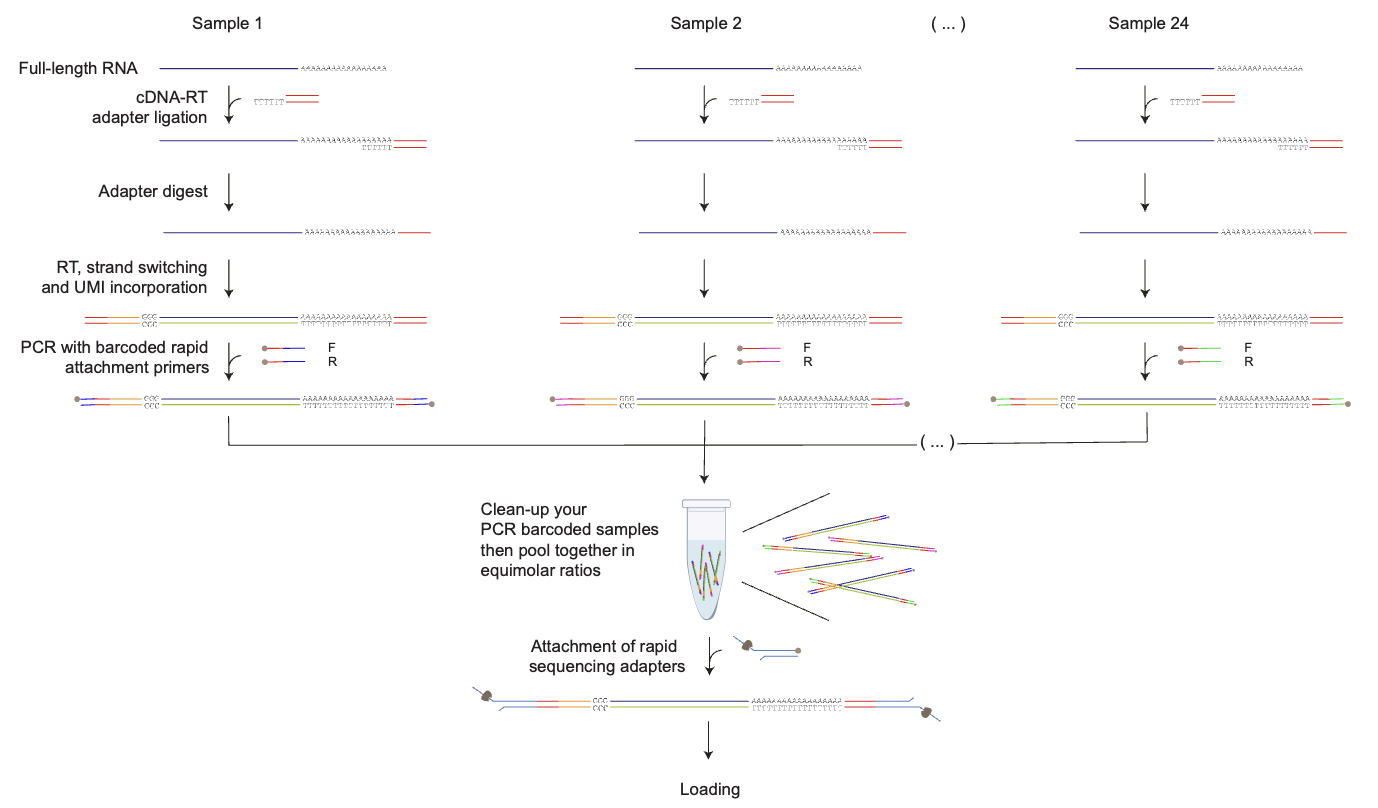
cDNA-PCR Barcoded Sequencing service uses Oxford Nanopore long-read technology to explore transcript structure and diversity. The workflow converts RNA into cDNA and enriches for full-length transcripts through PCR, supporting the identification and characterization of transcript isoforms, alternative splicing patterns, and fusion transcripts. Using the cDNA-PCR Barcoding Kit V14 (SQK-PCB114.24), up to 24 individually barcoded samples can be pooled in a single sequencing run, enabling efficient comparisons across experimental conditions. Library preparation requires just 10 ng of enriched RNA or 500 ng of total RNA per sample and incorporates unique molecular identifiers (UMIs) during strand switching. The library design also supports poly(A)-tail length estimation with compatible analysis tools, providing additional opportunities to investigate transcript features.
Highlights
- Long-read cDNA sequencing with PCR enrichment for full-length transcripts.
- Supports identification and characterization of transcript isoforms, alternative splicing, and fusion transcripts.
- Low input requirements: 10 ng enriched RNA or 500 ng total RNA per sample.
- Incorporates unique molecular identifiers (UMIs) during strand switching.
- Supports poly(A)-tail length estimation using compatible analysis tools.
- Enables multiplexing of up to 24 individually barcoded samples in a single sequencing run.
Sample submission requirements
| Service | Sample type | Minimum amount | Quality |
|---|---|---|---|
| cDNA-PCR barcoding | Enriched RNA (Poly(A)+ or ribodepleted) or total RNA | ≥20 ng enriched RNA (Poly(A)+ or ribodepleted) or ≥1ug total RNA per sample |
High-quality RNA (RIN ≥ 7)
|
- Extract RNA and assess length, quantity, and purity using the Input DNA/RNA QC protocol.
- Ensure you have the sequencing kit, equipment, and third-party reagents.
- Download the acquisition software and verify that the flow cell has sufficient pores.
Service Workflow
Data Analysis
After library preparation, prime the flow cell and load the pooled barcoded library. Start a sequencing run with MinKNOW, which collects and basecalls reads. Barcodes can be demultiplexed and UMIs used to correct PCR duplicates using EPI2ME workflows or custom analysis pipelines.
Useful documents
- Original protocol: cDNA-PCR Sequencing V14 Barcoding (SQK?PCB114.24) (PDF)